
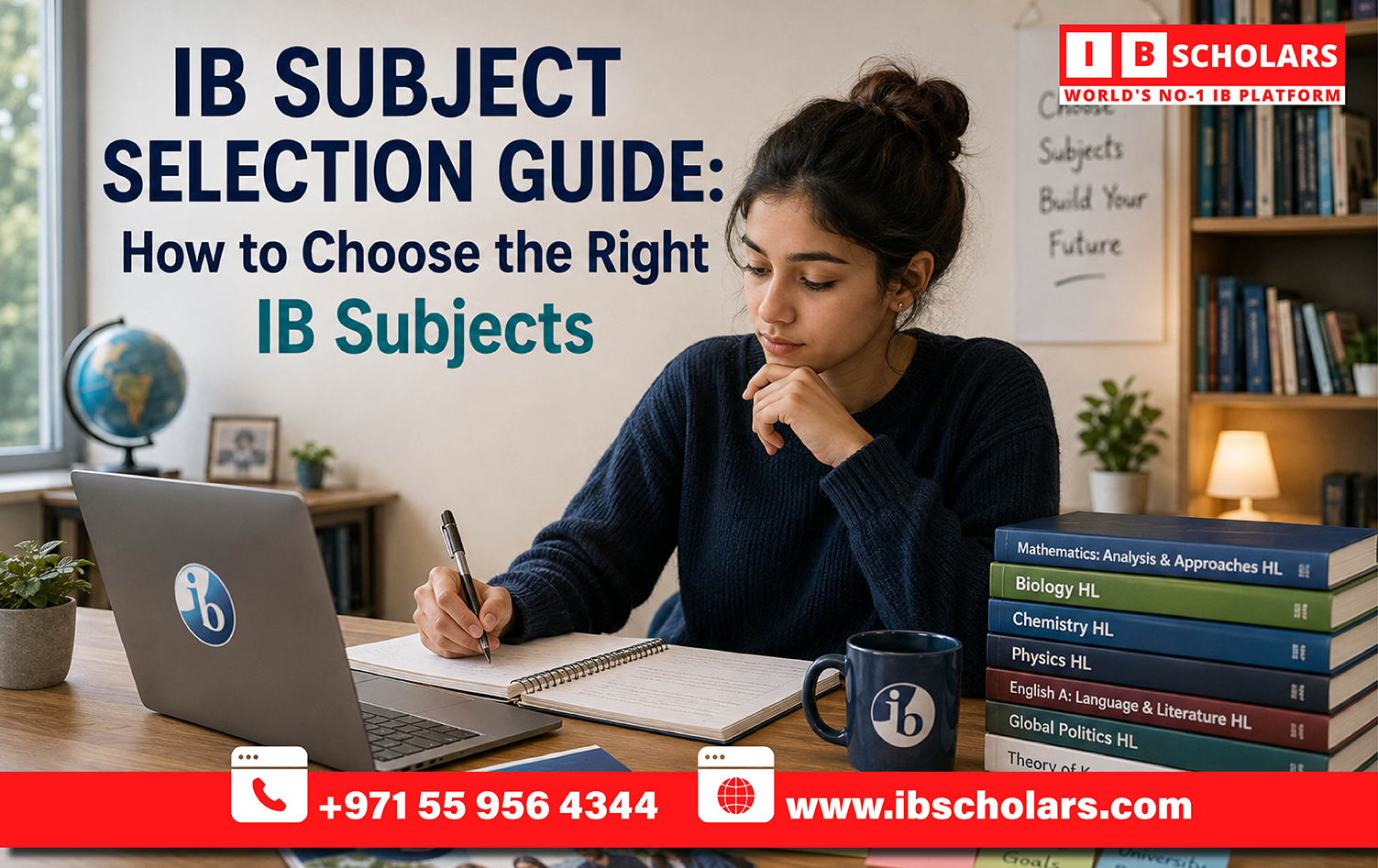
IB Subject Selection Guide: How to Choose the Right IB Subjects
The International Baccalaureate (IB) is an international education programme that aims to produce academically gifted, curious and internationally minded students. Its Diploma Programme (IBDP) was established in 1968 by teachers at the International School of Geneva with the goal of providing a well-rounded education that would foster international understanding and facilitate the transfer of students between countries. The IBDP is now a two-year programme for students from 16-19 years of age, which includes six subject groups and the three core components of the IB: Theory of Knowledge, the Extended Essay, and Creativity, Activity, Service.
How does IB subject selection actually work?
Typically, IBDP students choose six subjects, one from each of the six subject groups: Studies in Language and Literature, Language Acquisition, Individuals and Societies, Sciences, Mathematics, and the Arts. Students can sometimes replace the Arts subject with an additional subject from another group.
This enables students to have breadth of study, while still allowing them to specialise through their Higher-Level choices.
What's the difference between HL and SL?
Students take between three and four Higher Level (HL) subjects, with the remainder studied at Standard Level (SL). HL subjects are more extensive and in-depth, with the IB recommending that there should be around 240 teaching hours for HL as compared to 150 for SL.
The key question isn't just "Which subject is easier?" Rather, students should ask: Which subjects suit my abilities, interests, and my future plans?
Should university plans influence subject selection?
Definitely. Subject options may impact access to specific university courses. For instance, a student interested in medicine may be required to study certain science subjects and an aspiring engineer may be required to study combinations of Mathematics and Physics.
The IB itself recommends checking individual university admission requirements and consulting university or careers counsellors before making choices.
Should students just pick the subjects they like?
Enjoyment matters, but it should not be the only consideration.
The right mix is a balance of interest, academic abilities, workload, university requirements, and long-term goals. Students who enjoy Biology but do not enjoy laboratory work should consider carefully whether Biology HL is suitable for them. In the same way, a student who wants to study Economics should ask himself whether he is comfortable with analytical writing and quantitative reasoning.
How should students choose their HL subjects?
HL subjects usually deserve the most careful consideration because they involve more extensive content and skills.
Students should think about subjects that they have performed consistently and are genuinely interested in. They should also consider which subjects are most relevant to their intended university course.
For instance, IB's own sample combinations include a potential engineering pathway consisting of Physics: HL and Mathematics: Analysis and Approaches: HL, while a medicine-oriented combination can include Chemistry HL and Biology HL.
Can students change their IB subjects later?
Perhaps, but it depends on the school, timetable, the syllabus coverage, and the level of progress made by the student. Changing subjects after teaching has begun can create significant gaps.
This is why it's preferable to make an informed choice before you start the programme, instead of choosing subjects based on what friends are studying.
What are the biggest mistakes students make when choosing IB subjects?
A common error is choosing a subject that seems “easy.” Another is selecting the same subjects as friends when they are not the ones you are best at or have career aspirations for.
Students should also avoid assuming that a particular HL subject is automatically required simply because it sounds impressive. Students should always check the university requirements directly.
Most importantly, students should consider the entire combination, not individual subjects in isolation. The workload of a demanding combination of several HL subjects may be quite different from what students were anticipating.
Book a Consultation with Amourion
If you are still uncertain about which subjects you want to study in IB, make an appointment with our experts at Amourion. We can discuss at length the academic strengths, university goals, subject combinations, and difficulties of subject selection at HL and SL level. Amourion has branches in JLT, Sheikh Zayed Road, Dubai Silicon Oasis (DSO), and Hamdan in Abu Dhabi, providing students with personalised IB guidance in Dubai and Abu Dhabi.
Contact Us
Phone: +971 55 956 4344 | +971 4355 4850
Visit: www.ibscholars.com
Email: ib@ibscholars.com
WhatsApp: Click here to text us
Dubai Centers: Sheikh Zayed Road │ Jumeirah Lakes Towers │ Dubai Silicon Oasis Abu Dhabi: Hamdan Street
Curricula: IB | A Level | AS Level | IGCSE | American.
Modes: In Person | Hybrid | Online.